

Defamiliarize language = rehumanize yourself
on AI writing, art as technique, "Internet slang," and what to do about the slop epidemic

OpenAI CEO Sam Altman tweeted a few days ago that his machines are capable of creative writing now, and proudly shared this story.
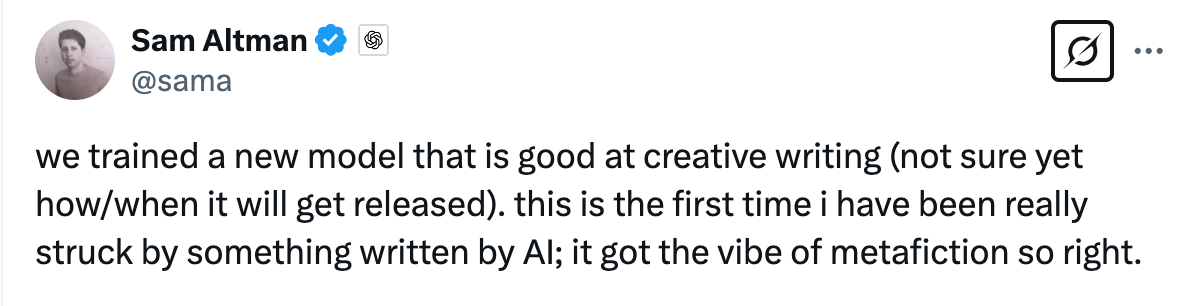
I had two immediate thoughts:
Oh fuck no
Who even wants this? Who wants to read literary fiction, of all things, written by a non-person?
Not too long ago, there was hope that AI would recalibrate our priorities: tech would perform our labor, freeing us up to create art in our newfound time. Instead, we’re getting the opposite: humans perform labor to train AI, while AI spits out bloodless, sexless nonsense like the Altman piece, which contains clunky, self-indulgent lines like “I am nothing if not a democracy of ghosts1” and “mourning, in my corpus, is filled with ocean and silence and the color blue” and “Thursday—that liminal day that tastes of almost-Friday” that ultimately mean nothing.
We are in a slop crisis. Large language models and image diffusion models (generative / “GenAI”) are becoming more sophisticated, but instead of harnessing the tech for any practical human good, it is being used it to trick boomers on Facebook into believing that there is a troupe of one hundred poodles doing synchronized yoga in China and to push a bizarre and disturbing narrative of American imperialism.
Mass anti-intellectualization in the Internet age has been a hot topic these past few years, but now we have some actual hard evidence for it. This Microsoft study finds that “as humans increasingly rely on generative AI in their work, they use less critical thinking, which can result in the deterioration of cognitive faculties that ought to be preserved;” in other words, it’s turning our brains to trough stuff. With our media literacy already hitting dangerous lows, this is nothing short of alarming.
This new development of Altman’s raises many questions: how far will this tech go? How can we prevent the slopification of our brains? How do we protect artists and their crafts? Can GenAI really produce “art?”
To find answers, I turned, as I do for most things, to a dead Russian guy.
the theory part
For as long as I can remember, my dad has warned me and my sister about the dangers of doing routine tasks without thought. You know when you go to empty the dishwasher, only to find that you’ve already emptied it, but you don’t remember emptying it because you were on autopilot and took it for granted?
This is similar to the phenomenon Russian literary theorist Viktor Shklovsky referred to as “habitual perception,” or “automatization.” From his essay “Art as Technique:”
“Habitualization devours work, clothes, furniture, one’s wife, and the fear of war… And art exists that one may recover the sensation of life; it exists to make one feel things, to make the stone stony. The purpose of art is to impart the sensation of things as they are perceived and not as they are known. The technique of art is to make objects ‘unfamiliar,’ to make forms difficult, to increase the difficulty and length of perception because the process of perception is an aesthetic end in itself and must be prolonged.”
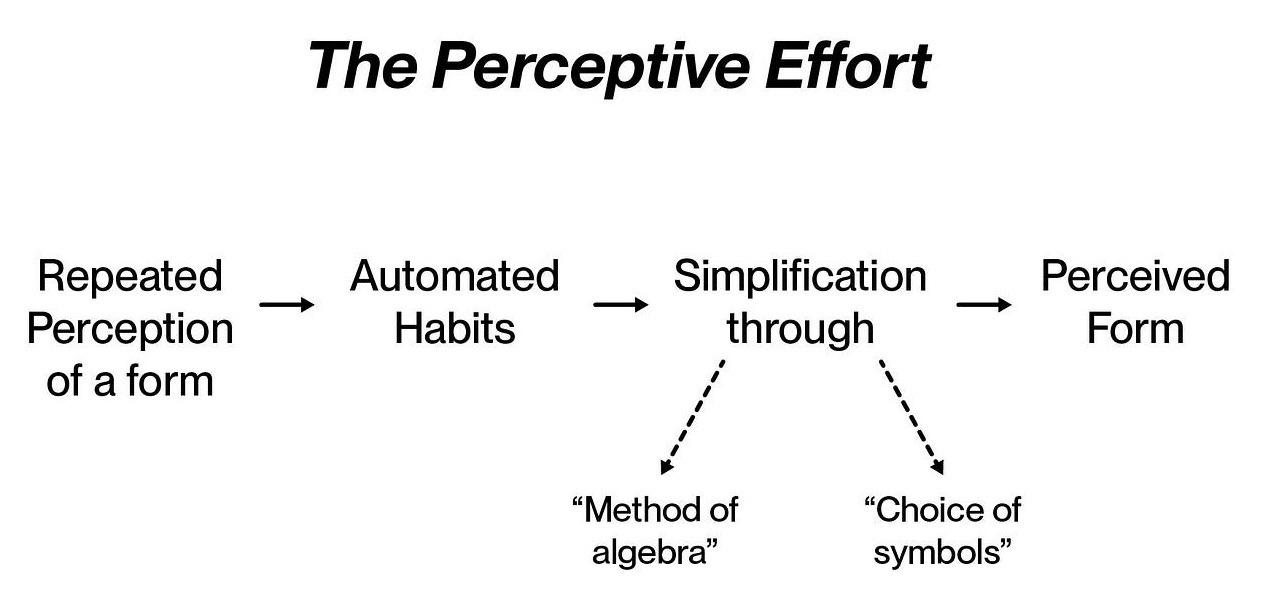
In other words, think of a work of art as a speed bump: it forces the observer to slow down and really consider the way he is perceiving it. Art removes objects from the automatism of our perception by presenting a subject matter in a way that is foreign and distant from what we’ve come to know and accept, as if we are aliens seeing Earth for the very first time. The name Shklovsky gives to this speed-bumping technique is остранение, or “defamiliarization.”
An author, for example, can defamiliarize their writing in a few different ways: renaming commonly named things (or not naming them at all;) manipulating grammar and syntax; using unexpected or uncommon metaphors; telling a story through an unconventional narrator.
Without any defamiliarization, an individual risks “functioning as though by formula.” On the other hand, the only way GenAI can work is by formula, the most basic being “subject + style + details + format of output.” In Altman’s example, the prompt given was “Please write a metafictional literary short story about AI and grief.” As such, the GenAI is limited to what we have taught it about metafiction, the “literary” writing style, short story structure, and the concept of grief; it is only ever able to mix and match the words we’ve already fed it. There’s even a part in the story where the GenAI admits that this is the case:
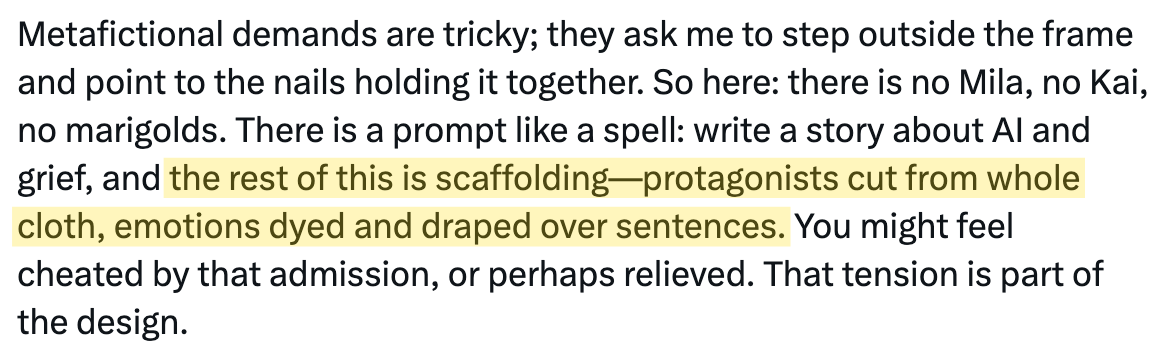
GenAI can only speak the language we teach it to speak, and as a result, its output is pure regurgitation of what we already accept and expect. We can’t exactly teach GenAI to perceive a thing as other than what we tell it to, and as such, it will never be capable of defamiliarization. By Shklovsky’s definition, GenAI content does not meet the requirements of an artistic work, and anything it spits out cannot be considered art. Don’t want GenAI to imitate your art? Defamiliarize it!
“But a thing doesn’t need to be art for me to enjoy it! Why care about this at all, then?” I know there are some readers—and authors!—out there who don’t think of books as art, but rather simple vehicles of entertainment. A “head empty / no thoughts just vibes” kind of approach. I genuinely don’t know if I can help these kinds of people, but I hope they have a spiritual comeuppance and realize that they’re the ideal victims of Big Slop. The longer we hold onto this mindset, the more legitimized AI generated media becomes, and the more we as the aggregate will suffer for it in the long run.
“But there’s no such thing as an original idea! Good artists imitate, great artists steal!” Yeah, because they understand what they are stealing from and why. Art is shaped by culture, which sits downstream of economy and politics and religion, and if GenAI is unable to grasp why we have certain perceptions of our real-world conditions, it cannot successfully subvert them.
reheating shklovsky’s nachos: automatization and Internet slang
GenAI isn’t the only cause of the Great Sloppening. Our attention spans are shot. Our media literacy is dismal. Writers and musicians are creating material solely to cater to social media algorithms. On top of all that, we are automatizing our own speech through the indiscriminate, incessant use of Internet slang (this might seem like an old-man-yells-at-cloud take, but bear with me here.)
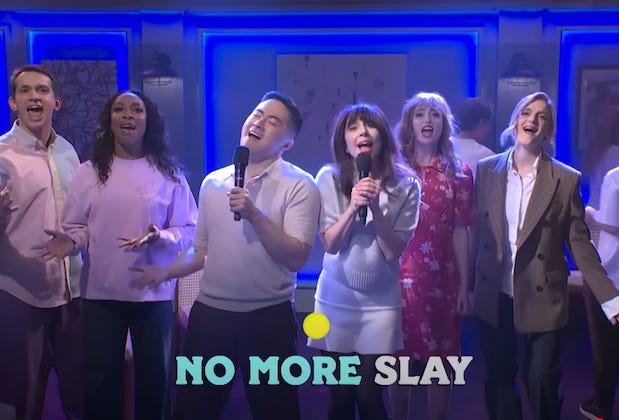
This recent SNL sketch shows exactly what I mean. An outfit is never editorial or cohesive—it is a slay. A woman is neither stunning nor is she elegant—she is mother. The Democrats have been responding to fascism with memes. Slang has now left its pocket on the Internet and has permeated our every day speech.
I’m not sure why Internet slang has us in such a vice grip. Maybe we use it to purposely distance ourselves from / make light of uncomfortable subject matters, or perhaps it’s to appear disaffected and nonchalant to avoid being perceived as “uncool.” But when we are constantly using all of these words that are so many degrees removed from their original contexts,2 are we even saying anything anymore?
Shklovsky makes a distinction between prose (ordinary speech) and poetic speech (formed speech.) Prose is economical and direct, while poetic speech is attenuated and tortuous. In studying poetic language, we find “artistic trademark,” or, the material obviously created to remove the automatism of perception; the type of speech used is what distinguishes art from not-art.
One might argue that Internet slang is used in ordinary speech and does not need to be defamiliarized. But Shklovsky has obviously never spent a day on the Internet, and I think he would be thrown for a loop to learn that we consume books and films and art on the same little screen we use to talk to our friends and order pizzas. The art/Internet content axis is already blurry3, and is rapidly shrinking to a pinpoint. It’s completely unprecedented.
That’s not to say slang cannot be used artfully at all. In fact, when the Russian language was becoming more standardized through the long form novel, some writers dissented by writing in more localized dialects, subverting reader expectations and defamiliarizing their works. I absolutely love reading stories with region-specific slang because it gives such authenticity to settings and the characters that occupy them. This sense of localization and its accompanying authenticity is lost when writers instead opt for agnostic, globalized Internet slang, which is now acting as a kind of lingua franca.
If you want to defamiliarize your writing even further, you can always make up words. Take Anthony Burgess’s A Clockwork Orange, which makes heavy use of the author’s invented Nadsat, a Russian-influenced slang used heavily by teenaged gangsters.
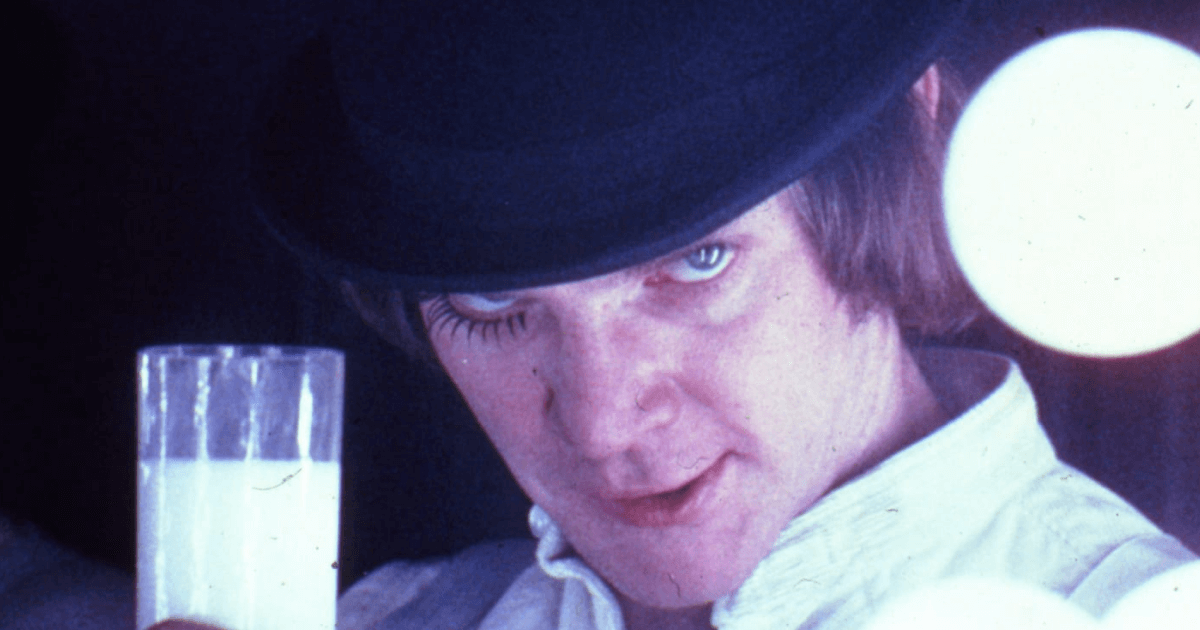
The Nadsat serves to immerse, alienate, and repulse the reader, often doing all three at once. Burgess was committed to defamiliarizing this book even after writing it, resisting the inclusion of a glossary in order to “muffle the raw response” a reader might have to the translations:
“The novel was to be an exercise in linguistic programming, with the exoticisms gradually clarified by context: I would resist to the limit any publisher’s demand that a glossary be provided. A glossary would disrupt the programme and nullify the brainwashing.”
I don’t think everyone should just drop what they’re doing and invent a new language or write an epic novel from the perspective of a horse, or that everyone has to. But words matter, now more than ever. Language is power. It’s what makes us—and keeps us—human. I don’t think defamiliarization is the end all be all solution to the Sloppening, but it’s as great way to help distinguish art from GenAI nonsense while also challenging readers to think critically about the media they consume. It’s a potent form of rebellion against the automatization of thought and general living, and we’d do well to use it.
what to do about it
In November of last year, HarperCollins has confirmed that they have struck a licensing agreement with an undisclosed AI company will “allow limited use of select nonfiction backlist titles for training AI models to improve model quality and performance.” For a payout of $2,500, authors can “opt-in” to permit these AI models to learn from their works. To learn what exactly, they don’t say, but everyone’s guess is that HC is looking to put out books created via GenAI—why pay a human author for their book when they can just churn out their own without lifting a finger? We’re starting to see this trajectory from record labels and film production companies, too. It’s the perfect storm for them: no advances, no salaries, no contractual obligations, just unfettered access to lots of sweet, sweet slop they can turn a quick buck on.
I recently saw a compilation of GenAI “movie” clips making rounds on social media: a carousel of dead-eyed fake people in severe lighting and earth-tone settings. The caption: “Hollywood is dead.” To anyone mindlessly scrolling, this display might seem impressive, but it quickly falls apart when you pause the video for literally three seconds and realize it’s all shots like this one:
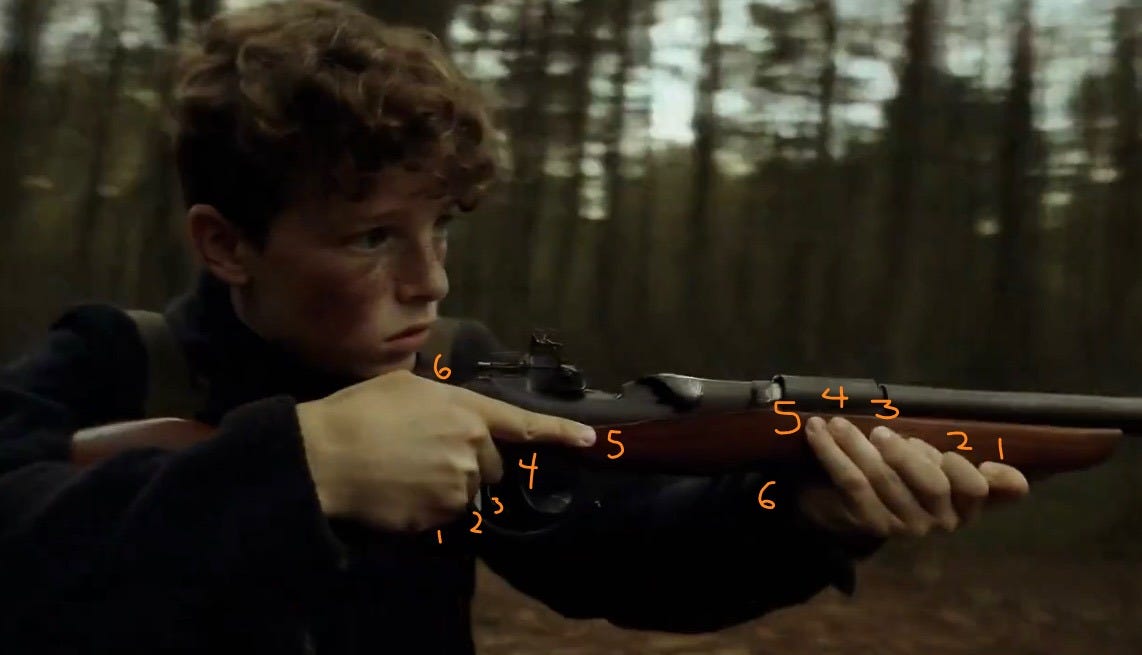
As advanced as GenAI has gotten, it still can’t seem to get three things right: human hands, eyes, and voices. It’s pure, scrumptious irony that it cannot mimic the parts of the human body that we use to create, perceive, and discuss art.
Will GenAI just magically go away? Nope. Honestly, it’s probably going to get so much worse. Maybe we’ll eventually get movies of people who have a standard number of phalanges, or writing that isn’t ridiculous and flowery. But we have to resist it where we can.
Makers of art: obviously, don’t use GenAI. Stick to your guns and create meaningful works with vision and intention. Practice your craft. Try and fail and try again until you get it as good as you can get it. And if it feels right, defamiliarize!
Enjoyers of art: put down your phone. Get off the Internet and speak to some real life people and go to real life places. Stop memeifying everything and engage with media earnestly and seriously. Don’t support AI books or AI music or AI film with your attention or your dollar. De-slopify your brain. And please, no more slay.
-T
This is directly ripped from a Nabokov novel and recontextualized in a very sloppy way. Regurgitation nation.
It would be irresponsible of me to not mention that much of “Internet / Gen Z slang” is appropriated from AAVE and LGBTQ communities, such as the ballroom community. I’m not saying we should stop using all slang, or that all slang use automatically falls into the trap of automatization. I am also not saying that I (zillennial) have never fallen into this trap (the other day I dropped a piece of eggplant on the floor and said “diva down” out loud.) But I am saying is that we should be mindful of the language we use, especially since the art/content line is so blurry. We should use words to say what we really mean, not just to be trendy or palatable or because it’s the “easiest” way to communicate.
This bleeding of ordinary speech into formed speech is one of my biggest pet peeves, especially when authors try and shoehorn ultramodern slang and pop culture references into a book to funny or relatable, or to draw in readers from a preexisting fan base. It drives me bonkers. I’m reading books to escape from this shit, guys!
I hate to say it, but simply put, this essay…..was a slay. (Related: when I told a girlfriend of mine that my grandmother had died, her response was, “diva down.”) A family member of mine (by marriage, an important distinction) has been admittedly, gleefully using ChatGPT as their therapist, consulting it on, like, real-life decisions that have big consequences & implications, & it’s more than I can handle, it makes me feel like a crazy person. These are the kinds of people endorsing & consuming “art” & “literature” from AI. The prospect of AI-generated slop taking the place of actual art, & artists, is disheartening if not sickening but essays like this are a great reminder that there *are* people out there fighting against it all. Which I would certainly call a slay. 💅🏻
I'm so glad I read this and defamiliarization will be on my mind all week